Boost Clients for Septic Services with Local SEO
Septic Service Marketing, Local SEO, Lead Generation
How Do Septic Service Companies Get More Clients?
If you run a septic service company, you already know how competitive your local market can be. The phone rings in waves, seasons affect demand, and it often feels like the same few companies always show up first on Google. The good news: with the right mix of online visibility, local partnerships, and smart follow-up, you can consistently attract more of the right clients—without guessing or burning cash on random ads.
Hero Image Concept (for your designer): A photorealistic scene of a septic technician in clean uniform standing beside a branded pump truck in a suburban driveway, shaking hands with a smiling homeowner—early morning light, tidy yard, and a subtle neighborhood backdrop that communicates trust, professionalism, and local service.
Step 1: Make Local SEO and Your Google Business Profile Work Harder
When homeowners search “septic pumping near me” or “septic inspection [your town],” Google usually shows a map with three companies at the top. If you are not consistently in that “map pack,” you are leaving money on the table. Local SEO and a fully optimized Google Business Profile (GBP) are the foundation of predictable new-client flow for septic service companies.
Dialing in your Google Business Profile
Start with the basics, then go deeper:
- Use your exact business name (no keyword stuffing) and correct categories such as “Septic system service,” “Septic tank cleaning service,” and related options that match your core services.
- Add a detailed description that mentions your primary towns, counties, and services—pumping, repairs, inspections, real estate inspections, installations, and emergency calls—written in natural language, not a list of keywords.
- List accurate service areas so Google understands where you are willing to drive, especially if you cover multiple rural counties.
- Keep hours, phone numbers, and website links updated—nothing kills a lead faster than a disconnected line or wrong hours during an emergency.
Next, add photos and posts regularly. Before-and-after drain field rehabs, clean trucks, team photos, and short posts about seasonal maintenance all signal that your business is active and trustworthy. This improves both rankings and conversions when people compare you against competitors.
Local SEO beyond your profile
Your website still matters. To attract septic clients from search engines:
- Create service pages for each major service (pumping, inspections, repairs, installations, grease traps) and for key towns or counties you serve.
- Answer common questions like “How often should I pump my septic tank in [county]?” or “What are signs my drain field is failing?” in blog posts and FAQs. This content helps you show up for voice searches and informational queries.
- Make sure your phone number is click-to-call on mobile and visible at the top of every page, with simple forms for quote requests and inspections.
If you want a clear roadmap tailored to your company, you can Get your free 12-month growth plan and see exactly which local SEO moves will make the biggest difference in your specific market.
Step 2: Use Google Local Services Ads (LSA) to Capture High-Intent Calls
Google Local Services Ads (LSA) are the “Google Guaranteed” boxes that show above regular ads and map results. For septic companies, LSAs can be a powerful way to get more phone calls from people ready to book right now— especially for urgent pumping, backups, and real estate inspections on tight timelines.
Why LSAs work so well for septic services
- You pay per lead (call or message), not per click—so wasted traffic is reduced if your screening questions are set up correctly.
- The “Google Guaranteed” badge builds instant trust, especially with homeowners who have never hired a septic company before.
- LSAs show your reviews, rating, and service area right in the ad, which helps you stand out if you have a strong review profile.
Making LSAs profitable, not painful
To get the most from LSAs, be intentional:
- Set your service types accurately so you are not paying for leads you cannot or do not want to service (for example, installations if you only pump and repair).
- Track which calls turn into booked jobs and revenue so you can adjust your bid, budget, and service area over time.
- Respond quickly—LSA heavily rewards fast response time and consistent answer rates. This is where automation can help, which we will cover later.
Step 3: Build Referral Partnerships with Real Estate Agents and Home Inspectors
Every real estate transaction with a septic system is a potential job for you. Real estate agents and home inspectors are constantly looking for reliable septic partners who show up on time, communicate clearly, and provide clean reports that do not blow up a deal unnecessarily. Becoming that trusted partner can create a steady stream of high-value inspection, pumping, and repair work.
How to win over real estate agents
- Attend local real estate association meetings or sponsor a breakfast, offering a short, educational talk on septic system basics for agents. Focus on helping them look smart in front of their clients, not selling your services directly.
- Create a simple “Septic for Real Estate” one-page PDF that explains your inspection process, typical turnaround times, and what buyers and sellers should expect. Make it easy for agents to share with clients.
- Offer priority scheduling for agents who use you regularly, especially when closing dates are tight and delays are costly.
Partnering with home inspectors
Some home inspectors are licensed to do basic septic checks, while others prefer to refer out full septic inspections. Either way, you can become their go-to expert by:
- Offering joint education sessions where you explain common septic issues and how to communicate them to buyers without causing panic.
- Providing fast, written reports with photos, clear recommendations, and simple language that inspectors can trust and reference in their own documentation.
The key is reliability: answer your phone, show up when you say you will, and protect the relationships agents and inspectors have with their clients. Do that, and referrals will follow.
Step 4: Proactive Outreach to New Construction Builders and Developers
New construction in your area means ongoing septic installation, design, and inspection opportunities. Instead of waiting for those calls to trickle in, you can intentionally build relationships with builders and developers who need a dependable septic partner on every project.
Where to find and approach builders
- Look up local building permits and subdivision plans to see which builders are active in septic-only areas (no municipal sewer).
- Attend home builder association meetings, trade shows, or local contractor events and introduce yourself as a specialist in reliable, code-compliant septic systems for new builds.
What builders actually care about
- Clear timelines and scheduling so septic work does not delay inspections or closings.
- Good communication with site supervisors and other trades on-site.
- Clean work, minimal callbacks, and systems that pass county inspections the first time.
Package your services in a simple proposal: design, install, inspections, and optional long-term maintenance plans for the new homeowners. Builders love turnkey solutions that make them look good and reduce headaches.
If you want help mapping out a builder outreach system—plus the online marketing that supports it—you can Claim your free growth plan and see how other septic companies are doing it successfully.
Step 5: Strengthen Relationships with Your County Health Department
In many areas, the county health department is deeply involved in septic permitting, inspections, and compliance. While they cannot “recommend” specific companies in a formal way, they absolutely know who does quality work, who submits clean paperwork, and who causes problems. Being on the right side of that reputation can quietly boost your business for years.
How to become the contractor they like working with
- Know the local codes and stay up to date on any changes. Attend public meetings or training sessions they offer and ask thoughtful questions about best practices, not just minimum requirements.
- Submit complete, accurate paperwork on time. Incomplete forms and constant resubmissions waste staff time and create friction that can quietly hurt your reputation.
- Be professional and respectful during inspections—even when you disagree on a detail. Long-term, calm collaboration almost always pays off.
Over time, health department staff will naturally point homeowners, builders, and agents toward companies they know do honest, code-compliant work and make their jobs easier. You want to be on that short list.
Step 6: Put a Simple Review Generation System in Place
Reviews are the new word-of-mouth. When a homeowner chooses between three septic companies on Google, the one with the most recent, detailed five-star reviews usually wins. The problem is that happy customers are busy and forget to leave reviews unless you make it almost effortless.
Make reviews part of your standard process
- Train your techs to ask for reviews on-site after a good experience: “If I text you a quick link, would you mind leaving a short review about today’s service? It really helps local homeowners find us.”
- Send an automated text or email within an hour of the job finishing, with a direct link to your Google review page and very simple instructions. The easier it is, the more reviews you will get.
- Respond to all reviews—good and bad. Thank happy clients and calmly address any negative feedback, showing future customers that you care and take responsibility.
Aim for a steady stream of new reviews every month, not a big spike once a year. Recency matters to both Google and homeowners, and it directly supports your local SEO and LSA performance.
Step 7: Use AI-Powered Lead Follow-Up Automation So You Never Miss a Call or Message
You can have great SEO, strong ads, and solid partnerships—but if you miss calls, forget to reply to messages, or take hours to respond to quote requests, you will still lose clients to competitors. That is where AI-powered follow-up and automation give septic companies a real edge.
What AI follow-up looks like in a septic business
- When a lead calls after hours, they automatically receive a text message acknowledging the call, asking a few key questions (address, issue, timing), and letting them know when to expect a callback—without you lifting a finger.
- When someone fills out a website form for an inspection or installation quote, the system instantly replies, gathers missing details, and offers a few appointment windows for your office to confirm in the morning.
- For unbooked estimates, the system checks back in a day or two: “Just checking in—do you have any questions about the quote we sent over?” This gentle nudge alone can recover a surprising number of jobs.
Why this matters for getting more clients
- Homeowners with a backed-up septic tank are not going to wait around— they will call the first company that answers or responds quickly. AI helps you be that company, even when you are on another job or closed for the day.
- Consistent follow-up on quotes, inspections, and maintenance plans quietly increases your close rate, which means more revenue from the same number of leads.
Modern AI tools are designed to sound human, stay on-brand, and hand off to your team when a conversation gets more complex. You stay in control, but you are no longer relying on memory or sticky notes to follow up with every lead.
Pulling It All Together: A Simple Growth Blueprint for Septic Companies
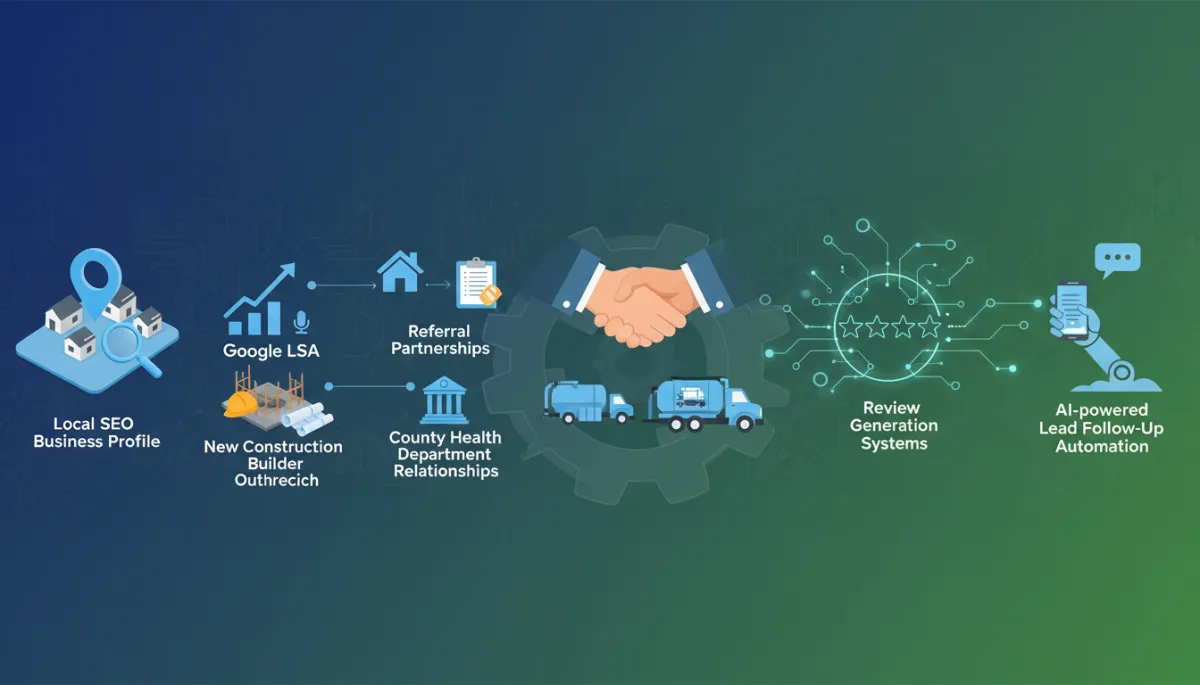
Growing a septic service business is not about chasing every shiny new marketing idea. It is about putting a few proven systems in place and letting them compound over time:
- Be visible where homeowners search. Local SEO and a strong Google Business Profile put you in front of people actively looking for septic help in your area.
- Capture high-intent leads. Google Local Services Ads bring in urgent, ready-to-book calls when every minute counts.
- Build referral engines. Real estate agents, home inspectors, builders, and even county health departments can all become steady sources of work when you make their lives easier and deliver consistently good service.
- Turn happy customers into social proof. A simple review generation system turns everyday jobs into five-star proof that you are the best choice in town.
- Automate follow-up so you never waste a lead. AI-powered messaging and reminders help you respond fast, answer common questions, and close more of the opportunities you already have.
You do not have to implement everything overnight. Many successful septic companies start with one or two areas—often reviews and Google Business Profile—then layer in LSAs, partnerships, and automation as they grow. What matters most is having a clear plan and sticking with it long enough to see the compounding results.
If you would like a customized roadmap that shows how these strategies could work in your specific market, including realistic numbers for call volume and revenue, you can Get your free 12-month growth plan and see exactly where to focus next to bring in more of the right septic clients—consistently and predictably.
SEO Title: How Do Septic Service Companies Get More Clients? (Proven Local Strategies)
Meta Description: Discover proven ways septic service companies get more clients using local SEO, Google Business Profile, Google LSA, referral partnerships, county relationships, reviews, and AI-powered follow-up automation.
Meta Keywords: septic service marketing, get more septic clients, septic company SEO, Google Business Profile septic, septic Google LSA, septic lead generation, AI follow-up for septic companies
