How Do Epoxy Flooring Contractors Get More Clients?
Epoxy Flooring, Marketing, Local SEO, Lead Generation
How Do Epoxy Flooring Contractors Get More Clients?
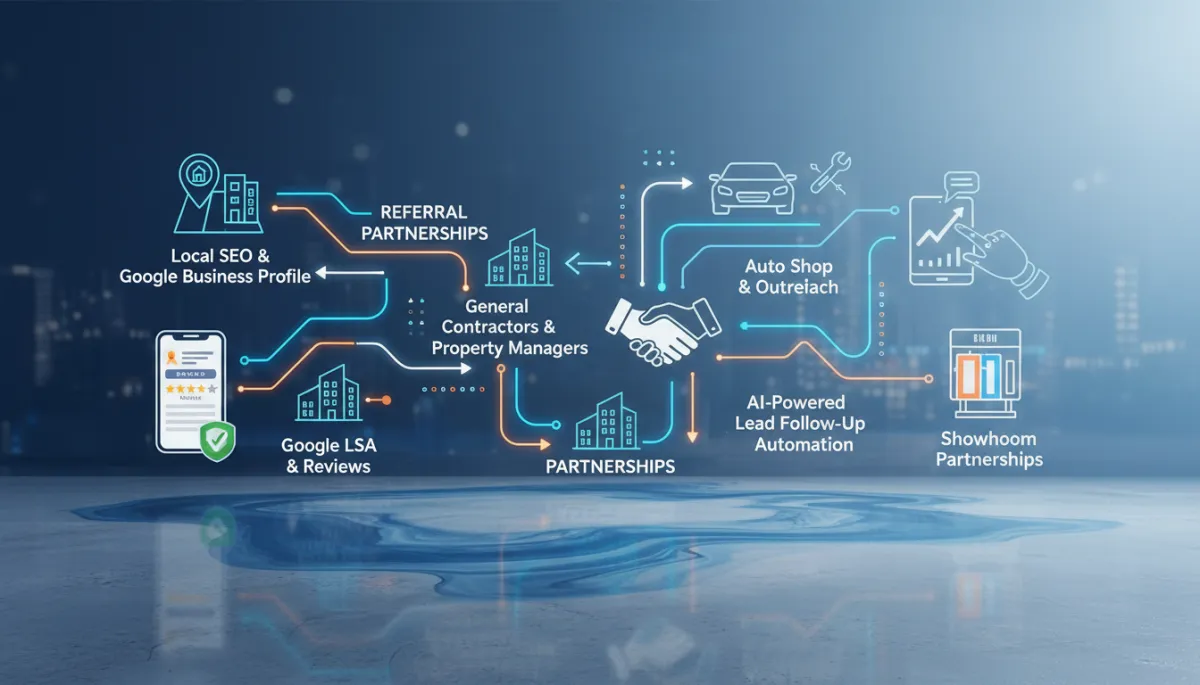
If you run an epoxy flooring business, you already know how competitive the market is. One month your phone is ringing nonstop, the next month you are wondering where the leads went. The good news: contractors who treat client acquisition like a system, not a guessing game, consistently stay booked out and grow year after year. This article breaks down exactly how epoxy flooring contractors can get more clients using local SEO, Google Business Profile, Google Local Services Ads, referral partnerships, outreach strategies, review systems, and AI-powered follow-up.
Step 1: Lock in Local SEO and Your Google Business Profile
For epoxy flooring contractors, local SEO is often the single most profitable channel. When someone searches “garage epoxy floor near me” or “industrial epoxy flooring contractor in [your city],” you want to appear in the map pack and at the top of organic results. That starts with a properly optimized Google Business Profile (GBP) and a website that speaks the language your ideal clients use.
Nail the basics of your Google Business Profile
- Use your exact business name (no keyword stuffing) and choose the most accurate primary category, such as “Flooring Contractor” or “Concrete Contractor,” then add relevant secondary categories if appropriate (e.g., “Epoxy Flooring,” “Garage Builder” if you qualify).
- Complete your service areas with the cities and suburbs where you actually want jobs, not the entire state. Quality beats quantity for local relevance.
- Write a clear, benefit-driven business description that includes phrases like “garage epoxy flooring,” “commercial epoxy floors,” “warehouse coatings,” and “industrial floor resurfacing” in natural language, not keyword stuffing.
- Add all relevant services (garage epoxy, flake systems, metallic epoxy, urethane topcoats, concrete grinding, moisture mitigation, etc.) with short descriptions that mention who they are best for (homeowners, auto shops, warehouses, showrooms).
Once the basics are dialed in, post consistently. Weekly Google Posts about recent projects, special offers, or FAQs signal to Google that your business is active and relevant. Respond to every question in the Q&A section and answer every review. These details often separate the contractors who show up in the top three map results from those buried on page two.
Local SEO on your website: speak your client’s language
Your website should be built around the search terms your ideal clients actually type, not just what sounds nice in a brochure. Create dedicated pages for key services and locations, such as “Garage Epoxy Floors in Denver,” “Commercial Epoxy Flooring for Restaurants,” or “Epoxy Floors for Auto Shops in Austin.” On each page:
- Use the city and service in the page title and headings (e.g., “Garage Epoxy Flooring in Phoenix, AZ”).
- Include real before-and-after descriptions of projects, the problems solved (oil-stained concrete, dusting, slippery surfaces), and the results (easy to clean, brighter workspace, more professional appearance).
- Add clear calls-to-action (CTAs) for quotes and consultations on every page, plus a phone number that is clickable on mobile.
When local SEO and your Google Business Profile work together, you can generate a steady stream of inbound leads from homeowners, auto shops, and commercial clients who are already searching for epoxy flooring solutions in your area. To see how all of this fits into a 12‑month plan specific to your market, Get your free 12-month growth plan.
Step 2: Use Google Local Services Ads (LSA) to Capture High-Intent Leads
Google Local Services Ads (LSA) are the “Google Guaranteed” listings that appear above regular ads and search results. For many home services, they are one of the most cost-effective ways to get in front of ready-to-buy prospects. While availability varies by region and category, if LSAs are open to flooring or concrete contractors in your area, you should strongly consider them as part of your lead mix.
Why LSAs work so well for epoxy flooring
- You pay per lead, not per click, which often results in a more predictable cost per booked job when your intake process is strong.
- The “Google Guaranteed” badge builds instant trust with homeowners and small business owners who are nervous about hiring the wrong contractor.
- Leads come in via calls and messages, which means you can quickly qualify and schedule estimates if you respond fast.
To make LSAs profitable, focus on three things: accurate business information, strong reviews, and rapid response times. Google tracks how quickly and consistently you answer leads and uses that data to influence your ranking within LSA results. Set up notifications, assign someone to answer or return calls quickly, and track which campaigns are producing booked jobs, not just inquiries.
Step 3: Build Referral Partnerships with General Contractors and Property Managers
While online marketing brings in a steady flow of leads, referral partnerships can create large, recurring projects that dramatically increase your average job size. Two of the most valuable partners for epoxy flooring contractors are general contractors and commercial property managers.
General contractors: become their go-to epoxy specialist
Many GCs would rather bring in a specialist for epoxy flooring than try to self-perform or sub it to a random crew. Your goal is to become the default choice whenever epoxy, coatings, or concrete resurfacing shows up in their scope. To do that:
- Identify GCs who frequently build or renovate restaurants, warehouses, auto dealerships, showrooms, and retail spaces in your area. These projects often include epoxy or similar systems.
- Reach out with a short, professional email or call offering to review their upcoming projects and provide budget numbers, system recommendations, and technical support at no charge.
- Make it easy to work with you: clear insurance documentation, safety protocols, and dependable scheduling. GCs value reliability as much as price.
Commercial property managers: recurring floor upgrades and maintenance
Commercial property managers oversee portfolios of warehouses, retail centers, industrial buildings, and mixed-use spaces. They constantly deal with worn, unsafe, or unattractive floors. Position yourself as the partner who can help them reduce complaints, improve safety, and make spaces easier to lease. For example:
- Offer a free floor condition walkthrough for their properties, documenting areas with spalling concrete, trip hazards, or failing coatings, and propose phased upgrade plans that fit their budgets.
- Provide maintenance and recoat schedules so they can plan capital expenditures instead of reacting to emergencies.
- Share before-and-after case studies that show how upgraded epoxy floors helped other properties attract better tenants or reduce slip-and-fall risk.
A single strong relationship with a GC or property manager can be worth dozens of residential jobs. The key is consistent follow-up, clear communication, and delivering flawless work when they give you the opportunity.
Step 4: Target Auto Shops and Garage Owners with Direct Outreach
Auto repair shops, detailing studios, tire shops, and small industrial garages are ideal epoxy flooring clients. They battle oil stains, chemical spills, and heavy traffic every day. Yet many of them have never had a contractor clearly explain the benefits of a properly installed epoxy or polyaspartic system. Direct outreach can change that.
How to approach auto shops and garages effectively
- Build a simple list of local auto-related businesses in your area: independent mechanics, body shops, detailers, tire shops, RV storage facilities, and fleet garages. A quick Google Maps search can easily generate dozens of prospects within a short drive of your shop.
- Create a short one-page sales sheet that highlights benefits tailored to them: brighter workspace, easier cleanup, improved safety, more professional appearance for customers, and resistance to oil and chemicals. Include photos, a short testimonial, and a clear call-to-action to request a quote or site visit.
- Visit in person during slower hours, introduce yourself to the owner or manager, and offer a quick 5-minute floor assessment. Even if they are not ready now, you will be top of mind when they are.
You can reinforce these visits with email follow-ups, short videos showing similar projects, and occasional check-ins. Unlike homeowners who may only do one project every decade, auto shops and garages often expand, relocate, or open additional bays, creating repeat opportunities when you stay in touch. To see how outreach like this can plug into a broader growth system, Claim your free growth plan.
Step 5: Partner with Showrooms and Complementary Businesses
Another powerful way to get more epoxy flooring clients is to embed yourself where your ideal customers already shop. Showrooms and complementary businesses can act as marketing channels for your services, often at very low cost compared to traditional advertising.
Showroom partnerships that generate steady leads
- Kitchen, bath, and home remodeling showrooms: Many homeowners upgrading kitchens, cabinets, or closets are also thinking about improving their garage or basement. Offer to install a demo epoxy floor section in the showroom with your branding, brochures, and QR codes that lead to a dedicated landing page.
- Auto dealerships and detail studios: A clean, glossy, flake epoxy floor can dramatically improve how vehicles look under showroom lighting. In exchange for discounted pricing on their own floor, ask for a small sign and a mention in their sales process for customers considering garage makeovers.
- Decor and storage companies: Closet and storage system companies often serve the same homeowners who value organized, attractive garages. Cross-referral agreements, co-branded mailers, or joint open-house events can introduce your epoxy solutions to their client base.
The key with showroom partnerships is to make it a win-win. Provide them with a floor or display that makes their space more attractive and easier to sell from, and in return, they introduce you as a trusted partner to their customers. Track referrals and periodically review performance so both sides see the value clearly.
Step 6: Implement a Review Generation System (Not Just Occasional Requests)
High-quality online reviews are one of the strongest predictors of whether a prospect will call you or your competitor. For epoxy flooring contractors, reviews carry extra weight because clients cannot “test” the product in advance—so they rely heavily on the experiences of others. The difference between 12 reviews and 150 reviews with photos is enormous in terms of trust and click-through rate.
Turn reviews into a repeatable process
- Decide on your primary platforms: for most contractors, Google is number one, followed by Facebook, and possibly niche directories depending on your region. Focus first on Google, where reviews directly affect your map ranking and LSA performance.
- Ask at the highest point of satisfaction—usually when the customer sees the finished floor for the first time. Train your crew leaders to say something like, “If you love how this turned out, a quick Google review helps more homeowners find us and supports our crew.”
- Send a follow-up text or email with a direct link to your review page (use Google’s “Write a review” link) and simple instructions. The easier you make it, the more reviews you will receive.
Consider offering a small, compliant thank-you gesture (like entering them into a quarterly drawing for a gift card) if allowed in your area. Most importantly, respond to every review, positive or negative, in a professional, friendly tone. Prospects read your responses as a window into how you handle communication and potential issues.
Step 7: Use AI-Powered Lead Follow-Up Automation to Protect Every Opportunity
Even with a strong marketing engine, many epoxy flooring contractors leak money because they do not follow up consistently with leads. Missed calls, delayed responses, and forgotten estimates add up to thousands of dollars in lost revenue every month. This is where AI-powered lead follow-up automation becomes a serious competitive advantage.
What AI follow-up can do for your epoxy flooring business
- Automatically respond to new leads from your website, Google Business Profile, LSAs, and social media with instant text and email replies, even after hours, so prospects feel acknowledged right away.
- Ask basic qualifying questions—garage size, current floor condition, timeline, location—so your team can prioritize high-value opportunities and arrive at estimates better prepared.
- Send reminders and follow-ups to prospects who requested quotes but did not yet book, using friendly, human-like messages that nudge them toward a decision without feeling pushy.
Instead of relying on memory, sticky notes, or overworked office staff, an AI-driven system ensures that no lead slips through the cracks. It works 24/7, keeps conversations organized, and hands your team warm, engaged prospects who are ready to talk details. When combined with strong local SEO, LSAs, referrals, and outreach, this kind of automation can dramatically increase your close rate and your revenue per marketing dollar. If you want to see how AI follow-up can plug into your existing systems, Get your free 12-month growth plan.
Bringing It All Together: A Simple Growth Framework for Epoxy Flooring Contractors
Each strategy we have covered—local SEO, Google Business Profile optimization, Google LSAs, referral partnerships, auto shop outreach, showroom collaborations, review systems, and AI-powered follow-up—can deliver results on its own. But the real power comes when you combine them into a single, repeatable growth system tailored to your epoxy flooring business, your market, and your capacity.
A practical way to structure your next 12 months
- Foundation (Months 1–3): Fully optimize your Google Business Profile, clean up and expand your website’s local SEO pages, and set up a simple review generation process that every crew follows at job completion.
- Lead Acceleration (Months 3–6): Add or refine Google Local Services Ads, start structured outreach to auto shops and garages, and secure at least one or two solid showroom or complementary business partnerships in your core service area.
- Partnership Expansion (Months 6–9): Deepen relationships with general contractors and commercial property managers, focusing on becoming their default epoxy partner for upcoming projects. Build simple case studies you can share across all channels.
- Automation and Scaling (Months 9–12): Implement AI-powered lead follow-up to capture more value from every channel, refine your pricing and sales process based on real data, and decide where to reinvest profits for the next stage of growth.
Throughout this process, track a few key metrics: number of leads per channel, booking rate from each source, average job size, and cost per acquired client. With even basic tracking, you can quickly see which strategies deserve more attention and which need to be improved or replaced. That is how epoxy flooring contractors move from “feast or famine” cycles to predictable, sustainable growth.
Conclusion: Build a Client Engine, Not Just a Busy Season
Getting more clients as an epoxy flooring contractor is not about chasing every new tactic or hoping for a lucky break. It is about building a simple, reliable engine that attracts the right prospects, converts them efficiently, and keeps them coming back or referring others. Local SEO and Google Business Profile optimization help you dominate the map pack. Google LSAs put you in front of high-intent homeowners and small businesses. Referral partnerships with general contractors and property managers unlock large, recurring projects. Auto shop and garage outreach fills your pipeline with ideal commercial jobs. Showroom partnerships put your work in front of clients who are already in a buying mindset. Review generation builds the trust that makes every other strategy more effective. And AI-powered follow-up ensures you capture the full value of every lead you earn.
You do not need to implement everything overnight. Start with one or two strategies, get them working, then layer in the next. Over time, you will create a marketing and sales system that supports your crew, stabilizes your schedule, and allows you to choose the projects and clients that fit your business best. If you want help mapping out exactly how these pieces should look for your market, capacity, and goals, you can Claim your free growth plan and get a tailored 12‑month roadmap to grow your epoxy flooring business with confidence.
