How Do Estate Planning Law Firms Get More Clients?
Estate Planning Marketing, Law Firm Growth, Client Acquisition
How Do Estate Planning Law Firms Get More Clients?
Estate planning is a relationship-driven practice, but relationships start long before a prospect walks into your office or schedules a Zoom call. Today, most new matters begin with a search query, a website visit, or a quiet recommendation from a trusted advisor. Firms that treat marketing as a structured, repeatable system — rather than a sporadic activity — consistently attract better clients, at higher fees, with less stress on partners and staff.
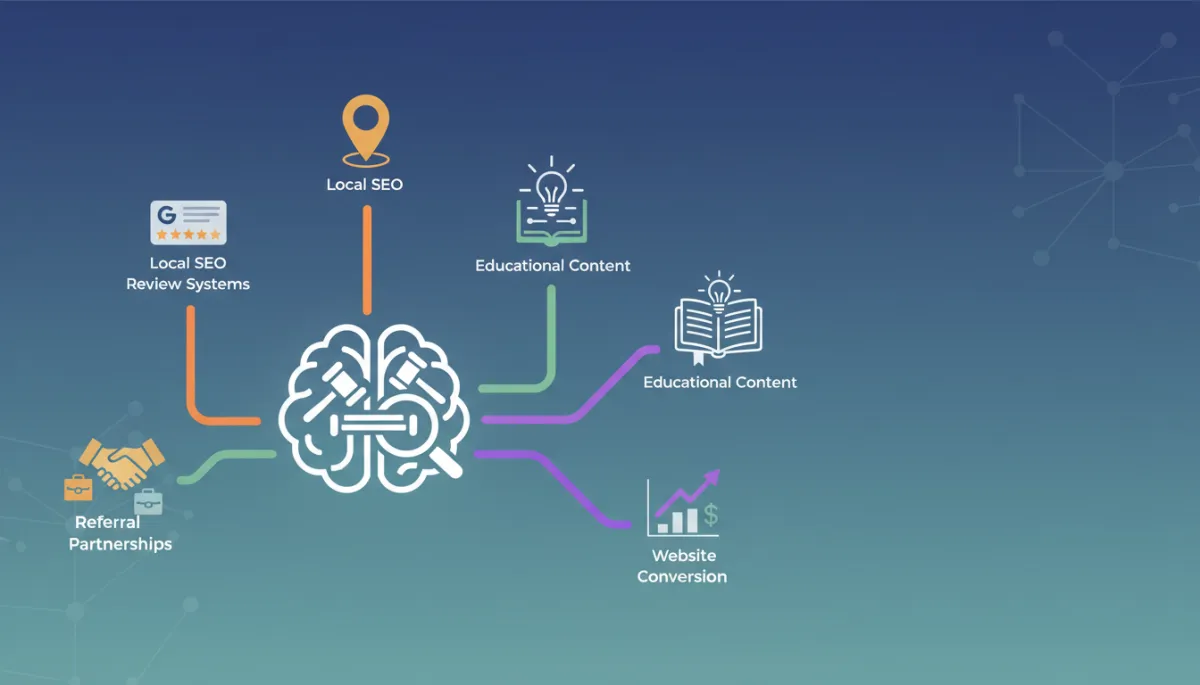
This article breaks down how estate planning law firms can reliably get more clients by focusing on six core pillars: local SEO, review systems, educational content marketing, Google Ads, referral partnerships, and website conversion. Together, these elements form a cohesive growth engine tailored to the realities of the estate planning niche.
1. Dominate Local SEO with an Optimized Google Business Profile
When someone types “estate planning attorney near me” or “will lawyer in [your city]” into Google, the results that appear in the local map pack are often the first — and only — options they consider. For an estate planning firm, visibility here is non-negotiable. That visibility is driven primarily by your Google Business Profile (GBP) and how well it is optimized for local search.
At a minimum, every estate planning firm should fully complete its GBP: correct name, address, phone number, practice area categories, hours, service areas, and a concise, keyword-rich description. Your description should naturally include phrases such as “estate planning attorney,” “trust and will lawyer,” and your primary geographic markets. Consistency across your website and legal directories helps Google trust your information, which directly influences rankings in local search results.
Beyond the basics, firms that win in local SEO treat GBP as a living asset. They add posts highlighting webinars, speaking engagements, or new guides. They list specific services such as “revocable living trusts,” “special needs planning,” or “business succession planning,” and ensure those services are also reflected on key landing pages. They track which search terms are driving calls and inquiries, then refine their on-page content to better match those high-intent keywords. Over time, this disciplined approach can move a firm from invisible to consistently visible for the search queries that matter most.
2. Build a Review System That Earns Trust Before the First Call
Estate planning is deeply personal. Prospective clients are not only evaluating competence; they are asking themselves, “Can I trust this person with my family and my legacy?” Online reviews are often the first proxy for that trust. A firm with a consistent stream of detailed, positive reviews on Google and other platforms will almost always win more inquiries than a comparable firm with only a handful of ratings, even if both rank similarly in search results.
The key is to move from passive hope to an intentional review system. This can be as simple as building a standard post-signing process: once a client signs their documents and expresses satisfaction, a staff member sends a short, personalized email with a direct link to your Google review page. Including a sentence such as “Clients often find us by searching for ‘estate planning attorney near me’ and your feedback helps them feel confident in choosing our firm” frames the request in a client-centric way rather than as a favor to the firm.
For higher volume firms, automated review request tools can be integrated with your practice management or CRM system, sending reminders at the right moment without adding administrative burden. Equally important is how you respond to reviews. Thoughtful, professional replies to both positive and negative feedback demonstrate that you are attentive, respectful, and proactive about client experience — qualities that matter greatly in estate planning engagements.
3. Use Educational Content Marketing to Pre-Qualify and Nurture Prospects
Many potential estate planning clients are not ready to hire counsel the moment they realize they need a will or trust. They may be gathering information, comparing options, or trying to understand the difference between a basic will and a more sophisticated estate plan. Firms that invest in educational content marketing position themselves as trusted guides during this research phase, which dramatically increases the likelihood that these prospects will eventually become clients.
Practical content formats include blog posts, FAQs, downloadable checklists (for example, “What to Bring to Your First Estate Planning Meeting”), short explainer videos, and email mini-courses that walk prospects through core concepts over several days. Each piece should focus on specific questions your ideal clients actually ask: “Do I need a trust if I already have a will?” “How does estate planning work for blended families?” “What happens if I do nothing?” When your content answers these questions clearly and empathetically, you reduce fear and confusion while demonstrating expertise.
Content should also be strategically aligned with search demand. Incorporate key phrases such as “estate planning for business owners,” “Medicaid planning attorney,” or “special needs trust lawyer” into articles and headings where appropriate. Over time, this helps your site rank organically for more long-tail searches, bringing in prospects who are already thinking about the specific services you provide. To turn that attention into action, include clear calls to action within your content, such as inviting readers to get your free 12-month growth plan tailored to estate planning firms that want to systematize their marketing.
4. Leverage Google Ads to Capture High-Intent Searches Immediately
While organic SEO and content marketing build momentum over time, Google Ads offers a way to appear in front of high-intent prospects almost immediately. Properly structured campaigns allow you to bid on phrases such as “estate planning attorney near me,” “living trust lawyer [city],” or “probate and estate planning law firm” and direct those clicks to highly relevant landing pages on your site.
The effectiveness of Google Ads in this niche depends on precision. Broad, unfocused campaigns often lead to wasted spend on low-quality clicks. Instead, estate planning firms should organize campaigns around tightly defined ad groups, each aligned with a specific intent category: general estate planning, high-net-worth planning, elder law and Medicaid strategies, business succession, and so on. Ad copy should speak directly to the concerns of that audience segment and promise a clear next step, such as a strategy session or document review call.
When combined with strong local SEO and a robust review profile, Google Ads can be a powerful accelerant. Many prospects will see your paid ad, your organic listing, and your reviews in one glance, which creates a reinforcing effect: visibility, credibility, and a clear path to contact. For firms that want to build this type of integrated acquisition system, it can be valuable to get your free 12-month growth plan and map exactly how paid search, local optimization, and on-site content will work together in your market.
5. Create Structured Referral Partnerships with CPAs and Financial Advisors
Some of the best estate planning clients will never search for a lawyer on Google. Instead, they will ask their CPA, financial advisor, or wealth manager whom they recommend. For that reason, referral partnerships remain one of the most powerful growth levers for estate planning firms — but only when approached intentionally rather than informally.
The starting point is clarity about the type of clients you serve best. Advisors are more likely to refer when they know exactly which situations trigger a strong fit: closely held business owners planning for succession, retirees concerned about long-term care costs, families with complex blended structures, or high-net-worth individuals with multi-jurisdictional assets. Providing concise one-page summaries of your ideal client profiles, sample planning scenarios, and your process helps advisors recognize opportunities early and feel confident in making introductions.
Strong partnerships are also reciprocal. While ethical rules limit how referrals can be compensated, you can offer value in many other ways: co-hosted educational events, joint client webinars, coordinated tax and estate planning reviews, or providing advisors with specialized memos on topics such as “estate planning implications of new tax legislation.” Regular communication, transparent status updates on referred matters, and a consistent client experience all reinforce the advisor’s trust that their clients are in excellent hands. Over time, a small number of well-cultivated CPA and advisor relationships can generate a steady stream of high-quality, pre-sold clients.
6. Turn Website Visitors into Consultations with Better Conversion Design
Attracting traffic is only half the equation. The other half is website conversion: how effectively your site turns anonymous visitors into consultations, calls, and booked matters. Many estate planning sites unintentionally create friction. They bury contact information, use vague calls to action, or overwhelm visitors with dense legal text that never clearly explains what happens next if someone wants help with their plan.
High-converting estate planning websites share several characteristics. They clearly state who the firm serves and what problems it solves in the first screen of the homepage. They present a simple, three-step process (for example: “Schedule a call, design your plan, sign with confidence”) that demystifies engagement. They make it easy to take action with prominent buttons for scheduling a consultation, calling the office, or submitting a brief intake form. They also include social proof — reviews, testimonials where permitted, case examples, and logos of professional associations — near key decision points on the page.
For firms serving multiple segments, dedicated landing pages for each audience (for example, “Estate Planning for Physicians,” “Planning for Families with Special Needs,” or “Business Owner Succession Planning”) can significantly improve conversion by speaking directly to that group’s concerns. Each page should align with the keywords, ads, and content that bring visitors there, creating a seamless journey from search to consultation. If you are unsure where to begin, it can be helpful to get your free 12-month growth plan and identify the highest-impact changes to your website and intake process based on your current traffic and goals.
Bringing It All Together: A Cohesive Growth System for Estate Planning Firms
None of these strategies exist in isolation. Local SEO ensures that when someone searches for an estate planning attorney in your area, your firm is easy to find. Your review system provides the social proof that builds trust before the first conversation. Educational content marketing nurtures prospects who are still in the research phase and positions your firm as the obvious choice when they are ready to act. Google Ads captures immediate, high-intent demand and amplifies your visibility. Referral partnerships with CPAs and financial advisors deliver sophisticated, pre-qualified clients who value coordinated planning. And a conversion-optimized website turns all of that attention into a predictable flow of new matters.
The firms that grow most predictably are not necessarily the ones with the largest marketing budgets. They are the firms that treat client acquisition as a system to be designed, tested, and refined. They measure which channels produce the most profitable matters, which messages resonate with their ideal clients, and which parts of their intake process create unnecessary friction. Then they double down on what works and systematically address the bottlenecks that remain.
If your estate planning firm is ready to move beyond sporadic referrals and ad hoc marketing, now is the time to design a deliberate, 12-month growth roadmap. Clarify your ideal client profiles, align your local SEO, reviews, content, ads, and referral relationships around those clients, and ensure your website makes it effortless for them to take the next step. For a structured way to do this, you can get your free 12-month growth plan and use it as a blueprint to build a marketing system that fits the unique dynamics of your estate planning practice and market.
SEO Title: How Do Estate Planning Law Firms Get More Clients? | Local SEO, Referrals & Conversion
Meta Description: Discover how estate planning law firms get more clients using local SEO, Google reviews, educational content, Google Ads, referral partnerships, and high-converting websites tailored to this niche.
