Boost Patient Growth in Dermatology Practices
Dermatology Marketing, Patient Acquisition, Practice Growth
How Do Dermatology Practices Get More Patients?
Dermatology has never been more in demand—yet many private practices still feel like they are “invisible” online or overly dependent on a handful of referral sources. In a market shaped by consolidation, digital-first patients, and AI-driven competition, growing your panel now requires a clear, repeatable acquisition strategy rather than one-off marketing experiments.
The New Reality of Dermatology Patient Acquisition in 2026
Several powerful trends are reshaping how dermatology patients choose providers. Private equity–backed groups are expanding aggressively, digital-native patients compare multiple dermatologists online before booking, and AI is changing how people research their own symptoms. Studies show that more than half of patients now trust online reviews more than traditional word-of-mouth, and platforms like Zocdoc report that over 80% of new dermatology patients rebook with the same provider once they have a good first experience. That means who wins the first appointment often wins the long-term relationship.
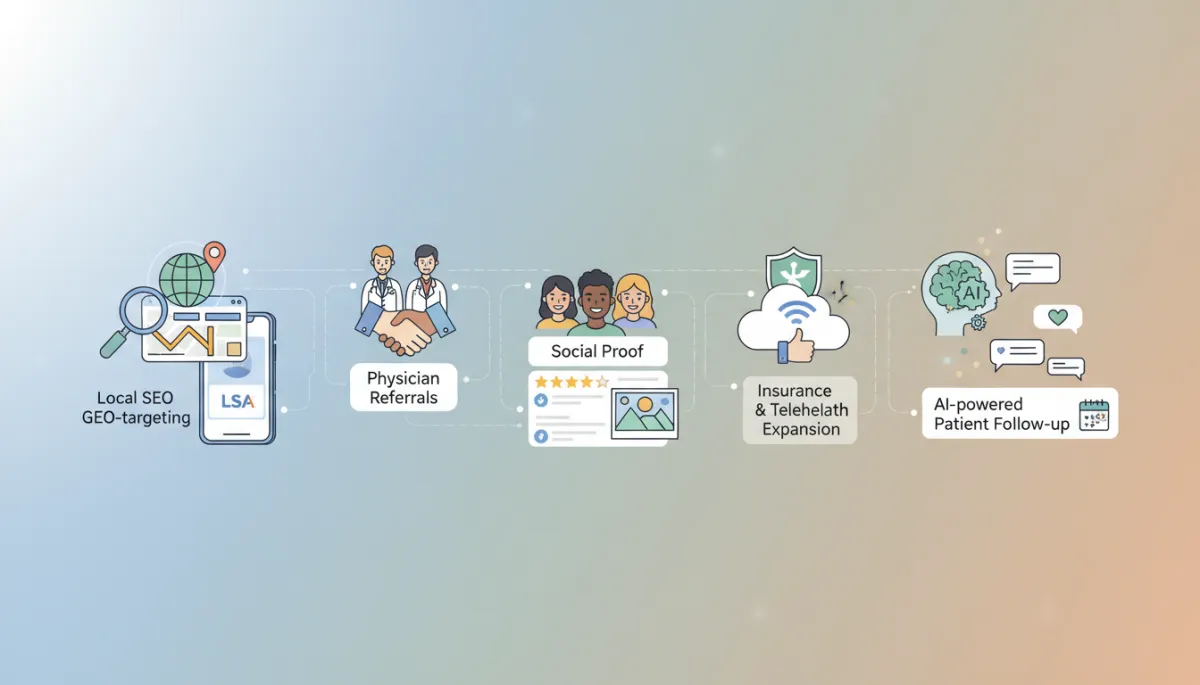
To compete—and grow—independently or within a group, dermatology practices need an integrated approach that connects visibility, conversion, and retention. The strategies below are the ones working best for high-performing practices in 2026, especially when tied together with data and smart automation.
1. Local SEO and Google Business Profile: Own “Dermatologist Near Me”
When someone searches “dermatologist near me,” “acne doctor in [city],” or “skin cancer screening near [neighborhood],” Google’s Local Pack and Map results are often the first—and sometimes only—options patients consider. That makes local SEO and Google Business Profile (GBP) optimization the foundation of modern dermatology growth.
Get the basics of your Google Business Profile right
Research on local SEO trends shows that a complete, accurate GBP is one of the strongest ranking signals for local healthcare searches. Make sure:
- Your name, address, phone number, hours, and website are 100% accurate and consistent with your site and directories.
- You choose precise categories (e.g., “Dermatologist,” “Skin Care Clinic,” “Cosmetic Dermatologist”) and list key services such as acne treatment, Mohs surgery, or cosmetic injectables.
- You use a clear, patient-friendly description with local keywords like “board-certified dermatologists serving [city/region] for medical, surgical, and cosmetic dermatology.”
Optimize for mobile and voice search behavior
Patients increasingly use voice search and mobile devices: “Hey Siri, find a dermatologist open now” or “Who treats psoriasis near me?” To capture this intent, your website and content should:
- Load fast and look great on phones, with click-to-call and online booking above the fold.
- Include FAQ-style content that mirrors natural language questions, such as “How often should I get a skin cancer screening?” or “Is acne treatment covered by insurance?”
- Use local schema markup (structured data) to help search engines understand your providers, locations, and services.
Local content and backlinks that signal authority
Google rewards dermatology practices that behave like real, trusted local authorities. You can strengthen that signal by:
- Publishing content about skin issues tied to your local climate (e.g., sun damage in Arizona, humidity-related acne in Florida, or winter eczema in the Midwest).
- Sponsoring or participating in local health fairs and skin cancer screenings, then earning backlinks from hospitals, news outlets, and community organizations.
- Listing your practice consistently in healthcare directories and local listings with identical name, address, and phone information.
Local SEO is not a one-time project; it is an ongoing system. Practices that review their GBP insights, track calls and bookings from Google, and adjust monthly tend to steadily climb in local rankings and patient volume.
If you want a customized roadmap that ties local SEO, reviews, and automation together for your specific market, Get your free 12-month growth plan and see exactly where your biggest opportunities are.
2. Google Local Services Ads: Pay Only for Real Leads
While traditional Google Ads can still work, many dermatology practices are seeing stronger economics from Google Local Services Ads (LSAs) where available. LSAs appear at the very top of local search results with a “Google Guaranteed” badge and operate on a pay-per-lead (not pay-per-click) model, which can be more predictable for practices watching their marketing spend closely.
For dermatology, LSAs are particularly powerful for high-intent searches like “same-day dermatologist,” “rash doctor near me,” or “skin cancer screening near me.” Patients who click these are often ready to book now, not just browsing educational content. To make LSAs work effectively:
- Ensure your licensing, insurance, and background checks are complete so you qualify for the program and the trust badge.
- Respond quickly to leads—speed-to-response significantly impacts booked appointments, and faster-access providers already see higher rebooking rates in dermatology data.
- Track which LSAs drive not just calls, but completed visits and rebookings, so you can adjust bids and service areas based on true ROI.
3. Primary Care and Internist Referral Partnerships That Still Work
Even as patients move online, primary care physicians (PCPs) and internists remain critical referral sources—especially for skin cancer, chronic dermatologic conditions, and complex rashes. However, the old model of dropping off brochures and hoping for the best is no longer enough, especially in markets with large dermatology groups courting the same referrers.
Strong referral partnerships are built on reliability, access, and communication:
- Offer expedited access for PCP-referred lesions, suspicious moles, and rapidly progressing rashes. A clear “urgent referral” lane can win loyalty quickly.
- Send concise, timely consult notes back to referring physicians so they feel looped in and confident in your care.
- Provide educational sessions or lunch-and-learns on evolving topics like biologics, melanoma screening guidelines, or acne management updates, positioning your team as an extension of their care.
When combined with strong online visibility, these relationships create a diversified acquisition engine: some patients come through digital channels, others through trusted clinical colleagues, and many through both over time.
4. Cosmetic Dermatology: Social Proof and Storytelling That Convert
Cosmetic dermatology patients behave differently from medical dermatology patients. They are more likely to discover providers on Instagram or TikTok, consume a lot of educational content, and scrutinize social proof before committing to treatment. In other words, they want to see that people like them have gotten safe, natural results with you.
Build a social ecosystem around education, not hype
Current dermatology marketing research highlights that educational content outperforms purely promotional posts. On social channels:
- Share short, clear videos explaining common cosmetic concerns: “What really causes melasma?”, “How to think about Botox vs. fillers,” or “What to expect from your first laser session.”
- Use geotags and local hashtags so people in your region actually see the content, not just a global audience that cannot book with you.
- Follow strict HIPAA and consent protocols for any before-and-after photos or patient stories.
Use structured social proof to reduce decision anxiety
For cosmetic services that are self-pay and often high-ticket, patients want reassurance. You can provide that through:
- Curated before-and-after galleries organized by concern (acne scarring, rosacea, pigmentation, wrinkles) and skin type, with realistic expectations described in plain language.
- Short written or video testimonials that focus on outcomes—confidence, comfort, subtlety of results—rather than just the technical aspects of a procedure.
- Clear, upfront information about pricing ranges, financing, and what is included, which increases trust and reduces no-shows.
When patients see consistent, authentic stories across your website, social channels, and reviews, they are far more likely to choose you over a faceless, corporate-feeling alternative.
To see how all of these channels can be orchestrated into one cohesive patient journey—from first Instagram reel to booked consult—Claim your free growth plan and benchmark your current funnel against top-performing practices.
5. Insurance Panels and Telehealth: Expanding Your Reach Ethically
Many practices underestimate how much patient volume is dictated by insurance participation and access options. In an environment where patients are increasingly cost-conscious, being in-network with key payers and offering teledermatology can significantly widen your funnel—especially for medical visits that lead to long-term relationships and downstream cosmetic interest.
Strategic insurance panel decisions
You do not need to be on every plan, but you should be intentional. Analyze:
- Which local employers and health systems dominate your region, and which commercial plans they favor.
- The mix of Medicare, Medicaid, and commercial payers in your patient base, and the reimbursement profile for common dermatology codes.
- Where there are gaps—plans that frequently appear in out-of-network inquiries or referral denials.
Thoughtful panel expansion, combined with clear messaging on your website and GBP about accepted insurance, can immediately increase call volume and online bookings from patients who previously assumed you were out of reach.
Telehealth as an access and retention lever
Teledermatology matured rapidly during the pandemic and has now settled into a sustainable role. While not appropriate for every condition, virtual visits are highly effective for:
- Acne follow-ups and medication adjustments.
- Chronic disease management (psoriasis, eczema) after an initial in-person evaluation.
- Quick triage of new lesions to determine urgency and the need for in-person care.
Prominently featuring telehealth options on your website, GBP, and referral materials can attract younger, tech-savvy patients and those in surrounding communities who are willing to travel for periodic in-person visits but want the convenience of virtual care in between.
6. Review Generation Systems: Turn Happy Patients into Growth
Online reviews have become one of the most powerful levers in dermatology patient acquisition. Surveys consistently show that patients rely heavily on reviews and that a higher rating, combined with recent, detailed comments, can dramatically increase call and booking rates—even when a competing practice is physically closer.
Make reviews a structured, automated process
Relying on occasional, ad-hoc review requests leaves your reputation vulnerable to a few unhappy outliers. Instead, build a simple system:
- After each visit, send a brief text or email thanking the patient and inviting feedback, with a direct link to your Google profile or other key platforms.
- Train staff to recognize delighted patients in person and ask them, genuinely and compliantly, if they would be willing to share their experience online.
- Monitor responses and route negative feedback to a private channel when possible, so you can address concerns offline before they escalate.
Respond professionally and consistently
Patients do not expect perfection, but they do expect professionalism. Responding to reviews—positive and negative—signals that you listen and care. For critical comments, avoid defensiveness and never share PHI; instead, acknowledge the concern and invite the patient to contact your office directly. Over time, a high volume of thoughtful, recent reviews becomes one of your most persuasive marketing assets.
7. AI-Powered Patient Follow-Up: Automating What Patients Feel as “Care”
Many dermatologists report feeling pressured to see more patients than is clinically ideal. At the same time, patients increasingly arrive with AI-generated self-diagnoses and high expectations for communication and access. The answer is not to work longer hours—it is to let AI handle more of the administrative and follow-up workload while you remain firmly in control of clinical decisions.
Where AI follow-up adds the most value
Thoughtfully deployed, AI can orchestrate a series of touchpoints that patients experience as attentive, personalized care:
- Post-visit instructions: Automatically send clear, dermatologist-approved care instructions after procedures (biopsies, excisions, peels, laser treatments), translated into patient-friendly language and multiple languages when needed.
- Medication adherence nudges: Gentle reminders to refill or continue topical and systemic medications for acne, psoriasis, or eczema, with links to FAQs about side effects and what to expect.
- Recall and rebooking: Smart reminders for annual skin checks, follow-up biopsies, or cosmetic maintenance (e.g., neuromodulator touch-ups every 3–4 months), tailored to individual treatment plans.
AI as the backbone of a measurable growth engine
The most advanced dermatology practices are now integrating AI-powered follow-up with their marketing and scheduling systems. Instead of disconnected tools, they have a single workflow that:
- Captures leads from Google, LSAs, social media, and referral sources into one pipeline.
- Uses AI to follow up with unbooked inquiries, reschedule cancellations, and send pre-visit prep and post-visit care.
- Tracks which channels and campaigns drive not just new patients, but retained and rebooking patients, so you can allocate budget with confidence.
This is where AI moves from a buzzword to a practical advantage: it quietly handles the repetitive communication that patients interpret as attentiveness, while freeing your team to focus on clinical care and high-touch interactions that truly require human judgment.
If you are curious what an AI-powered follow-up and acquisition system could look like for your specific practice—without adding another full-time staff member—Get your free 12-month growth plan and review a tailored blueprint with your leadership team.
Bringing It All Together: A Cohesive Growth Strategy, Not Random Tactics
Each strategy we have covered—local SEO, Google Business Profile optimization, Local Services Ads, referral partnerships, cosmetic social proof, insurance and telehealth expansion, review systems, and AI-powered follow-up—can move the needle on its own. But the practices seeing the strongest, most sustainable growth in 2026 are those that connect these pieces into a single, measurable system.
- Prospective patients discover you through search, social, or referrals and land on a fast, mobile-optimized site that makes booking effortless.
- Reviews, social proof, and clear service information reassure them that you are the right choice for their condition or cosmetic goal.
- AI and automation handle reminders, instructions, and recall so that each new patient has a high likelihood of becoming a long-term patient—and a source of future word-of-mouth.
In a consolidating market where private equity–backed groups are competing aggressively, this kind of integrated, data-driven approach is what allows independent and group dermatology practices alike to stand out, grow on their own terms, and remain attractive to both patients and potential partners.
Next Steps for Your Dermatology Practice
You do not need to implement everything at once. A practical path for most practices looks like this:
- Fix the foundations: optimize your Google Business Profile, website, and online booking experience so that every new visitor can easily become a patient.
- Turn on a simple, automated review-generation system and begin responding consistently to feedback.
- Layer in high-intent acquisition channels like Google Local Services Ads and structured referral programs with PCPs and internists.
- Build out cosmetic social proof and telehealth offerings, then use AI to automate follow-up, recalls, and patient education across the full lifecycle.
Done well, this approach does more than “fill the schedule.” It creates a resilient, patient-centric growth engine that supports your clinical goals, your team, and the long-term value of your practice—whether you plan to stay independent, grow, or eventually explore a sale or partnership.
If you are ready to see how these strategies could look in a concrete, quarter-by-quarter roadmap tailored to your market and capacity, you can Claim your free growth plan and use it as a strategic guide for your next 12 months of dermatology practice growth.
